Lab 001
The Living Starter
History · Microbiology · Observation
What makes a sourdough starter active?
Meet the wild yeasts and bacteria living in a jar of flour and water. Feed the starter, mark its rise, and draw it as it changes over a day.
Sourdough science subscription · Ages 5–12
Little Loaf Labs is a hands-on STEM and history curriculum delivered to your door. Kids grow a living starter, run real experiments, fill a field journal, and bake the bread they studied.
Designed for homeschool families and charter independent-study programs.
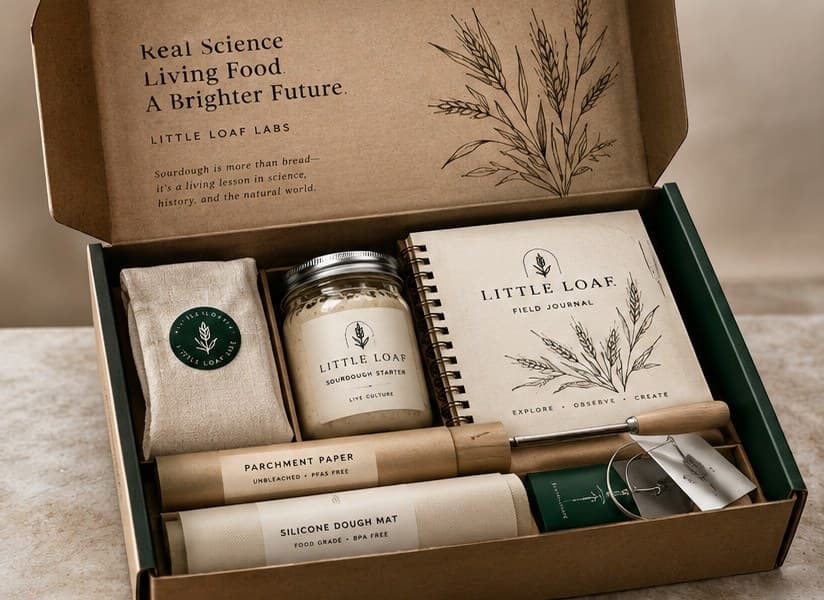
Prototype concept. Final kit in testing.
Measure·Mix·Observe·Experiment·Bake
More than a baking kit
Kids don’t just follow a recipe. They ask questions, make predictions, record data, and explain what happened, the way real scientists work.
Wild yeast, lactic acid bacteria, fermentation, temperature, and gas. Kids watch a living culture work and learn to explain what they see.
From the wheat plant and its kernel to the mill to bread made around the world for thousands of years.
Grams, ratios, fractions, and graphs, recorded in a field journal that kids draw in, write in, and keep.
How it works
Families buy the reusable equipment once. After that, each monthly box brings a new experiment, not another banneton.
A one-time kit with the field journal, live starter, reusable tools, and three guided labs. Everything a beginner needs for a first loaf.
Learn moreA new experiment each month: tortillas, pancakes, pizza, flour science. Each box has a lesson, recipe cards, journal inserts, and a specialty ingredient.
Learn moreThe journal fills up with drawings, data, and conclusions. It’s a keepsake for families and real student work for charter teachers.
Learn more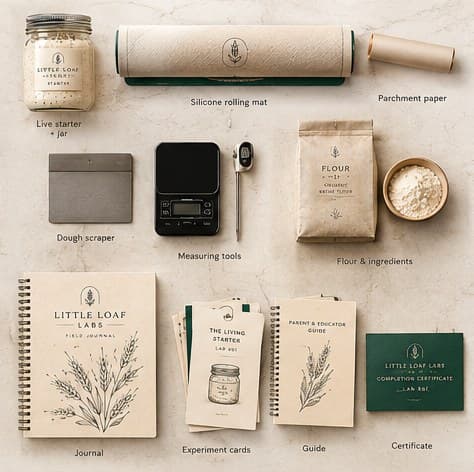
Inside the Starter Lab
Each piece has a job in the curriculum. Nothing is in the box just to fill space.
Every experiment, the same seven steps
A repeatable method kids can carry into any science they do next. Younger children draw and dictate, and older children write, calculate, and graph.
Step 1
Ask
What am I curious about?
Step 2
Predict
What do I think will happen, and why?
Step 3
Plan
What will I change? What stays the same?
Step 4
Observe
What do I see, smell, and measure?
Step 5
Draw & record
Sketch it. Write the numbers down.
Step 6
Explain
What does my evidence tell me?
Step 7
Reflect
What would I try next time?
The first three labs
The Starter Lab moves from a jar of bubbles to a finished loaf in three guided investigations.
Lab 001
History · Microbiology · Observation
What makes a sourdough starter active?
Meet the wild yeasts and bacteria living in a jar of flour and water. Feed the starter, mark its rise, and draw it as it changes over a day.
Lab 002
Experimental design · Measurement · Data
How does temperature change fermentation?
Run a real controlled experiment. Change one variable, keep the rest the same, measure the rise at set times, and graph the results.
Lab 003
Chemistry · Materials · Engineering
How do ingredients and process change dough?
Explore hydration, gluten, and the gas that dough holds. Then shape, score, and bake a first loaf, evaluate it, and plan one improvement.
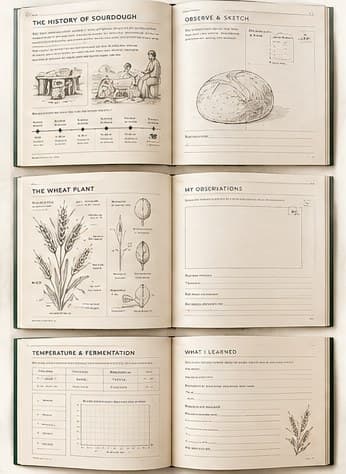
The Field Journal
Sixty-four pencil-friendly pages with sourdough history, wheat anatomy, feeding logs, temperature graphs, drawing spreads, and a final reflection. It lies flat, so it can stay open on the kitchen counter.
Grows with your child
Siblings can work side by side. Every lab has a version for each age band.
Ages 5–8
K–2
Picture-based observation, drawing, simple comparisons, and lots of adult-supported measuring. Kids can dictate notes to a grown-up.
Ages 8–10
Grades 3–5
Predictions, controlled comparisons, vocabulary, data tables, and first graphs. Kids write their own conclusions.
Ages 11–12
Grade 6
Variables, ratios, baker’s percentages, quantitative data, and evidence-based explanations, plus design improvements.
For charter & independent-study programs
Little Loaf Labs is built around the California Next Generation Science Standards, with learning objectives, a parent and educator guide, and student work samples. We’re preparing vendor applications with California homeschool charters now.
Charter-fund availability varies by school.
The founding 50
We’re opening a small first run while we finish testing the kit. Join the waitlist to get first access, founding pricing, and a Founding Baker number.