Lab 001
The Living Starter
What makes a sourdough starter active?
Meet the wild yeasts and bacteria living in a jar of flour and water. Feed the starter, mark its rise, and draw it as it changes over a day.
The Starter Lab
A one-time kit that sets up your kitchen laboratory. It holds the reusable equipment, the field journal, and the first three labs of the curriculum.
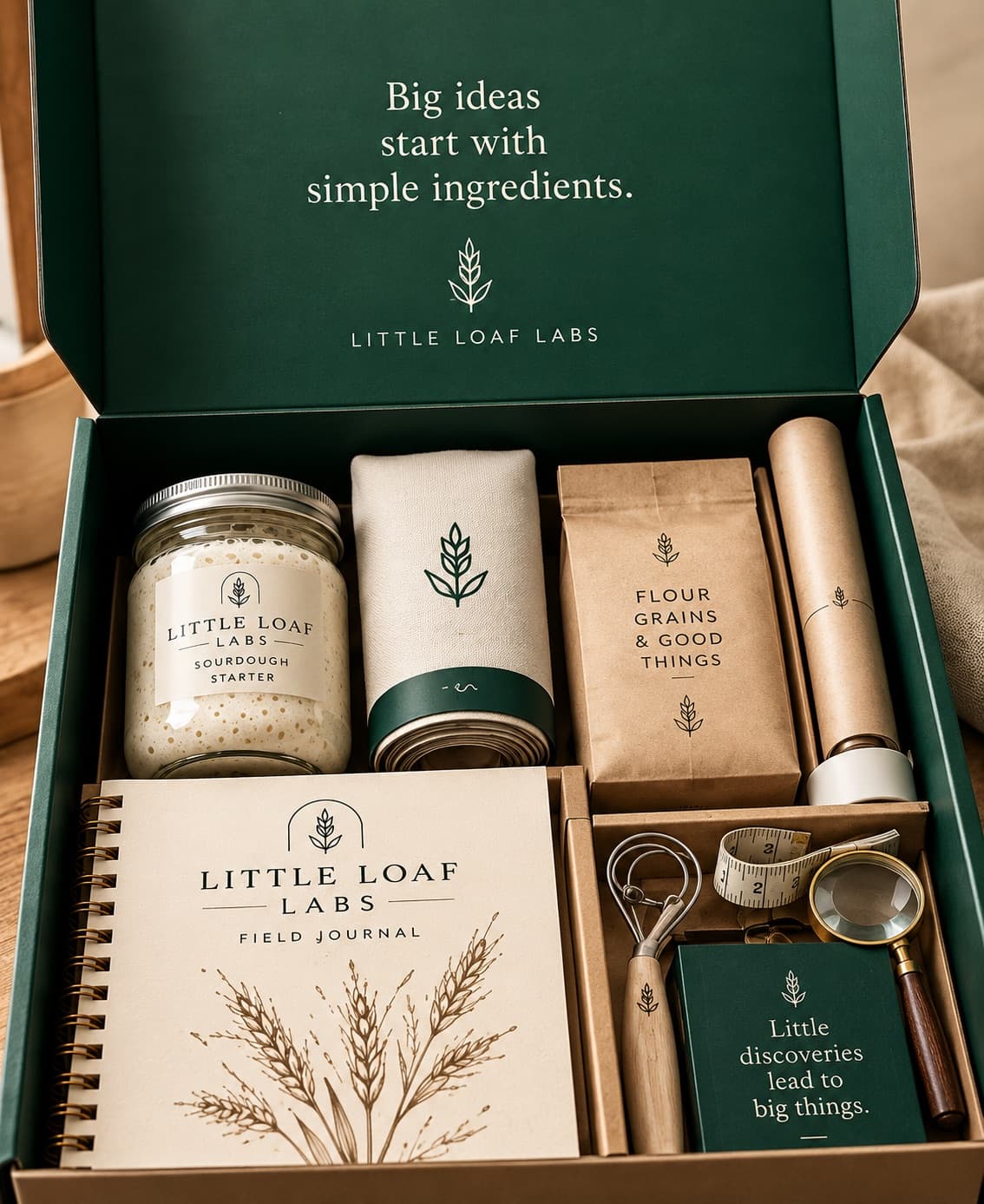
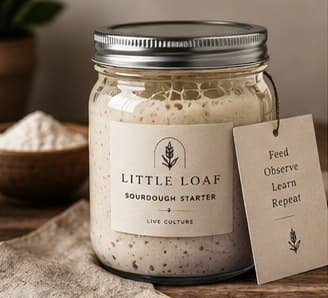
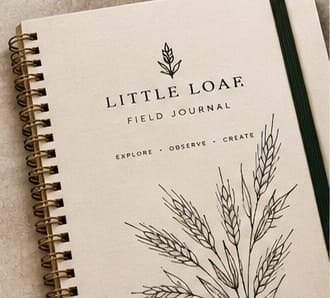
Prototype concepts. Final components are being sampled and tested.
What’s in the box
Field Journal
64-page, lay-flat botanical lab notebook. Drawing, notes, data, reflection.
Live sourdough starter
An established culture with feeding and care instructions.
Reusable starter jar
Wide-mouth glass jar with lid and a growth marker.
Silicone dough mat
Food-contact grade, with measurement rings for rolling and shaping.
Unbleached parchment
A compact roll for the first bakes.
Dough scraper
The one tool every baker reaches for.
Measuring tools
Gram scale and thermometer for the measurement and temperature labs.
Flour for Lab 001
Enough for your first loaf.
Science & history cards
Illustrated cards on microbes, wheat, and bread through time.
Three guided labs
Step-by-step experiments that build on each other.
Parent & educator guide
Prep time, supervision notes, talking points, and assessment.
Completion certificate
Because finishing a first loaf deserves a ceremony.
You’ll also need water, salt, an oven, and a Dutch oven or other lidded oven-safe pot for baking. Grown-ups handle anything hot.
Included labs
Each lab has a parent prep note, a 30–45 minute activity, a science concept, journal pages, and an extension for older kids.
Lab 001
What makes a sourdough starter active?
Meet the wild yeasts and bacteria living in a jar of flour and water. Feed the starter, mark its rise, and draw it as it changes over a day.
Lab 002
How does temperature change fermentation?
Run a real controlled experiment. Change one variable, keep the rest the same, measure the rise at set times, and graph the results.
Lab 003
How do ingredients and process change dough?
Explore hydration, gluten, and the gas that dough holds. Then shape, score, and bake a first loaf, evaluate it, and plan one improvement.
The full curriculum
The Starter Lab opens the curriculum, and Monthly Labs carry it forward. Together they cover:
History · Geography · Communication
Grain cultivation, ancient leavened breads, the invention of milling, and bread traditions across cultures. Kids draw a historic bread scene and build a timeline.
Plant biology · Earth systems · Materials
The wheat plant, the kernel, growing and harvest, milling, and whole wheat vs. refined flour. Kids label a wheat plant and map the field-to-kitchen journey.
Life science · Microbiology · Systems
Wild yeast and lactic acid bacteria, and how a starter is kept alive. Kids sketch bubbles, track rise, and model how the culture uses its food.
Experimental design · Measurement · Data
How temperature, time, feeding ratio, and hydration change fermentation. Kids write a hypothesis, change one variable, and graph what happens.
Physical science · Chemistry · Materials
Hydration, gluten development, gas production, elasticity, and the changes that turn dough into bread in the oven.
Engineering design · Mathematics · Evaluation
Set a baking goal, design a process, test a variable, and improve the method. This is where baker’s percentages finally click.
Add-ons
Available once founding orders open.
For a sibling, a second student, or a child who filled theirs.
A fresh culture with feeding instructions and a new jar label.
Sealed one-loaf packs or a family-size bag.
Single experiments like tortillas, pancakes, or pizza, without a subscription.
Safety first
The founding 50
We’re opening a small first run while we finish testing the kit. Join the waitlist to get first access, founding pricing, and a Founding Baker number.